Online Business Tools for Every Stage of Growth
Choosing online business tools gets easier when you start with the job your business needs to complete. A founder validating an offer needs a different toolset from a business trying to improve delivery or expand a working customer journey.
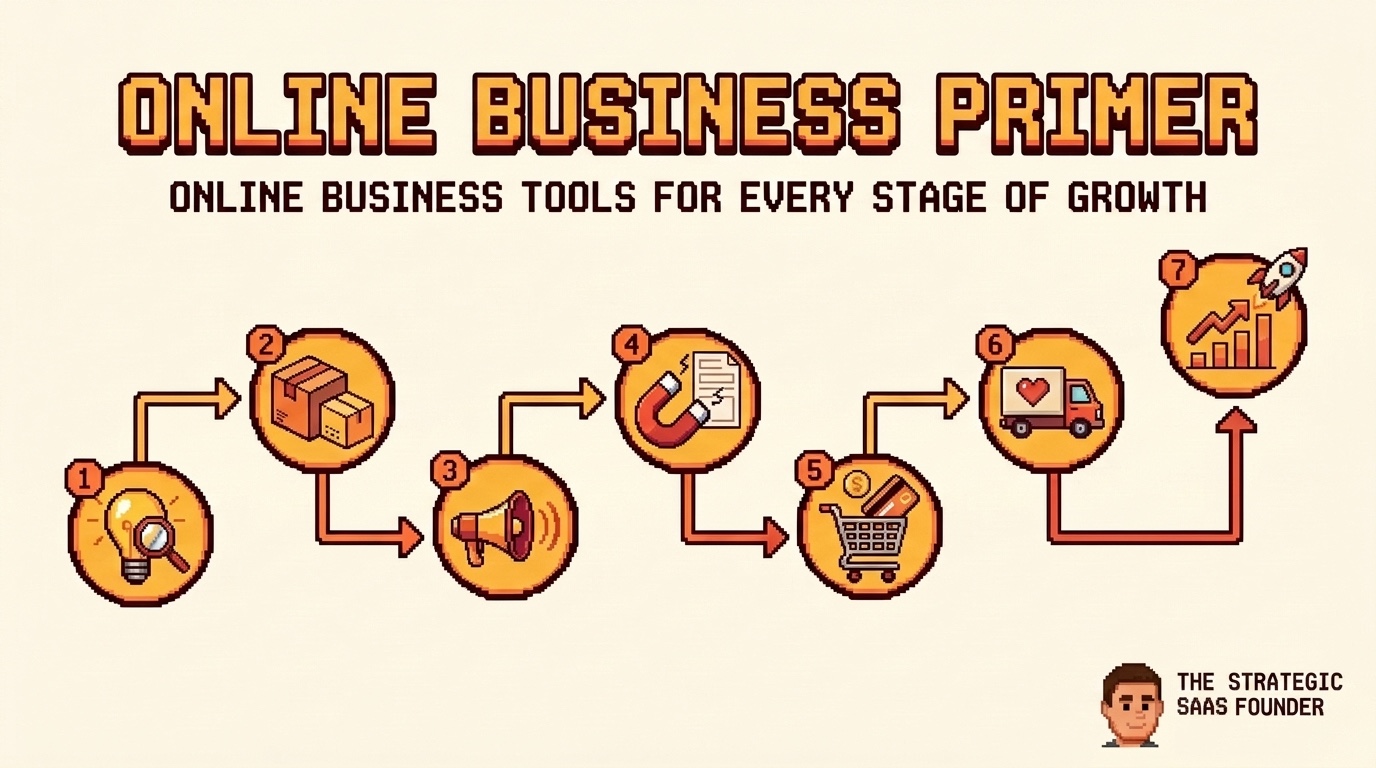
This guide organizes my current tool guides around seven stages: discovery, offer creation, awareness, engagement, conversion, delivery, and growth. Start with the stage that is limiting your business today. You do not need every tool on this page.
Table of contents
- 1. Discovery and validation
- 2. Offer creation
- 3. Awareness and acquisition
- 4. Engagement and lead capture
- 5. Conversion and checkout
- 6. Delivery and retention
- 7. Growth and optimization
1. Discovery and Validation
Find a viable market and validate the problem. Identify a specific group of people with a shared problem you can solve. Learn how they describe the problem, what they have already tried, what they pay for, and where current options fall short.
The goal is to define an audience, problem, and offer hypothesis with enough evidence to test. At the end of this stage, you should be able to explain who the offer is for, what problem it addresses, and why someone would choose it.
Use these guides during discovery and validation:
Research competing offers, positioning, customer language, content, and market gaps before deciding what to build or sell.
Ask prospects structured questions, collect first-party feedback, test assumptions, and learn how different audience segments describe their needs.
2. Offer Creation
Turn what you learned into an offer. Decide on the promise, format, scope, price, content, and customer experience. Build only what you need to test whether buyers understand the offer and are willing to pay for it.
The goal is to create a version you can explain, demonstrate, sell, and deliver. Choose the format around the customer result, whether that means a service, course, membership, digital product, workshop, or another model.
Use these guides to create the offer and its supporting content:
Organize research, notes, ideas, examples, and source material so you can turn what you know into useful content and repeatable processes.
Draft and improve lessons, sales copy, emails, articles, scripts, and supporting content while keeping editorial judgment in your hands.
Create brand graphics, lead magnets, presentation visuals, course materials, social posts, and other design work without a full design team.
Edit lessons, demonstrations, interviews, ads, webinars, and short-form clips into video people can understand and use.
3. Awareness and Acquisition
Help the right audience discover you. Publish useful content and distribute it through search, AI answers, social channels, video, partnerships, or paid campaigns.
The goal is qualified attention. Choose one or two channels that fit how your audience researches problems and evaluates options, then publish and distribute consistently enough to learn what earns attention.
Use these guides to attract the right audience:
Research search demand, improve pages, track rankings, review technical issues, and help potential customers find you through search engines.
Understand how your company appears in AI-generated answers and evaluate tools for prompt tracking, citations, competitor visibility, and content improvement.
Plan, publish, repurpose, and review social content without manually managing every post across every channel.
Build, monitor, and improve paid campaigns when you have an offer and landing path ready to test with targeted traffic.
Create and distribute video for demonstrations, testimonials, explainers, social campaigns, and other parts of the buyer journey.
4. Engagement and Lead Capture
Turn attention into an ongoing relationship. Give visitors a useful next step, such as joining your list, taking a quiz, requesting information, starting a conversation, or registering for an event.
The goal is to capture permission and context. A useful lead is someone who fits the audience, has shown interest, and has chosen to hear from you again.
Use these guides to capture and nurture qualified leads:
Build focused pages for lead magnets, waitlists, registrations, product launches, and campaigns without sending visitors through an unfocused website.
Use interactive questions to engage visitors, qualify leads, segment your audience, and recommend the next step based on their answers.
Answer common questions, guide visitors, qualify inquiries, and route people to the right page, person, or offer.
Collect subscribers, segment contacts, send newsletters, build automated follow-up sequences, and stay in touch until a lead is ready to buy.
5. Conversion and Checkout
Help qualified leads make a buying decision. Explain the offer, answer objections, demonstrate the outcome, provide proof, and give the buyer a simple way to pay or book the next step.
The goal is a dependable path from interest to purchase. Each step should help the buyer understand what they get, who it is for, what happens after payment, and how to proceed.
Use these guides to build the sales path:
Map and build the pages, emails, decisions, and follow-up steps that guide a prospect from first visit to purchase.
Run live, automated, or hybrid presentations that teach, demonstrate an offer, answer questions, and invite qualified attendees to buy.
Accept payment, present order options, recover abandoned checkouts, and connect the purchase to the next delivery step.
6. Delivery and Retention
Help customers get the result they paid for. Give each buyer the right content, access, support, communication, and next action. The platform should fit the way the customer needs to learn, participate, or work with you.
The goal is customer progress. Good delivery also improves retention, testimonials, referrals, repeat purchases, and the feedback you need to improve the offer.
Use these guides to deliver the offer and support customers:
Give clients a dedicated place for onboarding, files, tasks, updates, communication, resources, and personalized content.
Package lessons, track learner progress, manage access, and deliver a structured educational experience.
Manage recurring access to content, community, programs, resources, or services for a defined group of members.
Run coaching calls, workshops, consultations, team sessions, group programs, and customer support meetings online.
Host and deliver marketing or customer video with the access controls, playback experience, analytics, and integrations your use case requires.
7. Growth and Optimization
Improve the whole system. Review where qualified prospects drop out, which customers succeed, which channels produce profitable buyers, and which parts of delivery lead to retention or referrals.
The goal is to expand what already works. Use customer feedback and performance data to improve the offer, increase repeat purchases, test new channels, automate repeatable work, and return to discovery when you enter a new market.
Use these guides when you are ready to optimize and expand:
Run focused experiments across acquisition, activation, retention, referrals, and revenue once you have a working offer and customer journey.
Improve onboarding, customer education, re-engagement, renewal communication, cross-sells, and repeat purchases through segmented email.
Expand campaigns carefully after you know which audiences, messages, pages, and offers can turn paid visits into profitable customers.
How to Choose the Next Tool
Identify the stage with the clearest constraint, choose the guide connected to that job, and compare products for your use case. A larger software stack will not repair an unclear offer or a broken customer journey.
When the constraint changes, revisit the stages. The right online business tools should support the next useful action for your audience, your customers, or your team.
|
Join 10K+ readers of the Before You Build newsletter getting the playbook on SaaS tools, AI products & the signals, risks, & gaps to spot before going all in. |
No spam. Just data-driven insights from AppSumo’s most trusted product advisor, with 12 years and hundreds of product evaluations.