The Strategic SaaS Founder Manifesto: Make Software People Want to Buy

Software has never been easier to make.
We are about to drown in it.
More apps. More dashboards. More features copied from the same competitors. More AI text appearing inside tasteful purple boxes. More founders reaching launch day with a working product and no convincing answer to one basic question:
Why should anyone buy this?
I have spent more than 20 years designing, developing, integrating, testing and evaluating software. I have bought more than 540 products through AppSumo. Across my work, I have evaluated more than 1,000 SaaS products.
I see products while they are being tested, fixed, repositioned and prepared for launch. The software usually works. The dashboard loads. The button performs the task. The AI returns an answer in twelve seconds and everybody is briefly impressed.
Then the buyer arrives.
They compare it with the software they already use. A spreadsheet. A freelancer. ChatGPT. A manual process they already understand. Doing absolutely nothing for another six months.
And many perfectly functional products lose.
I have seen this too many times to keep treating it as a marketing problem that begins after launch.
A working product is the starting point.
A product that sells is the business.
Knowing how to get to a product that sells is the art.
Enough software in search of a customer
The current advice encourages founders to start immediately.
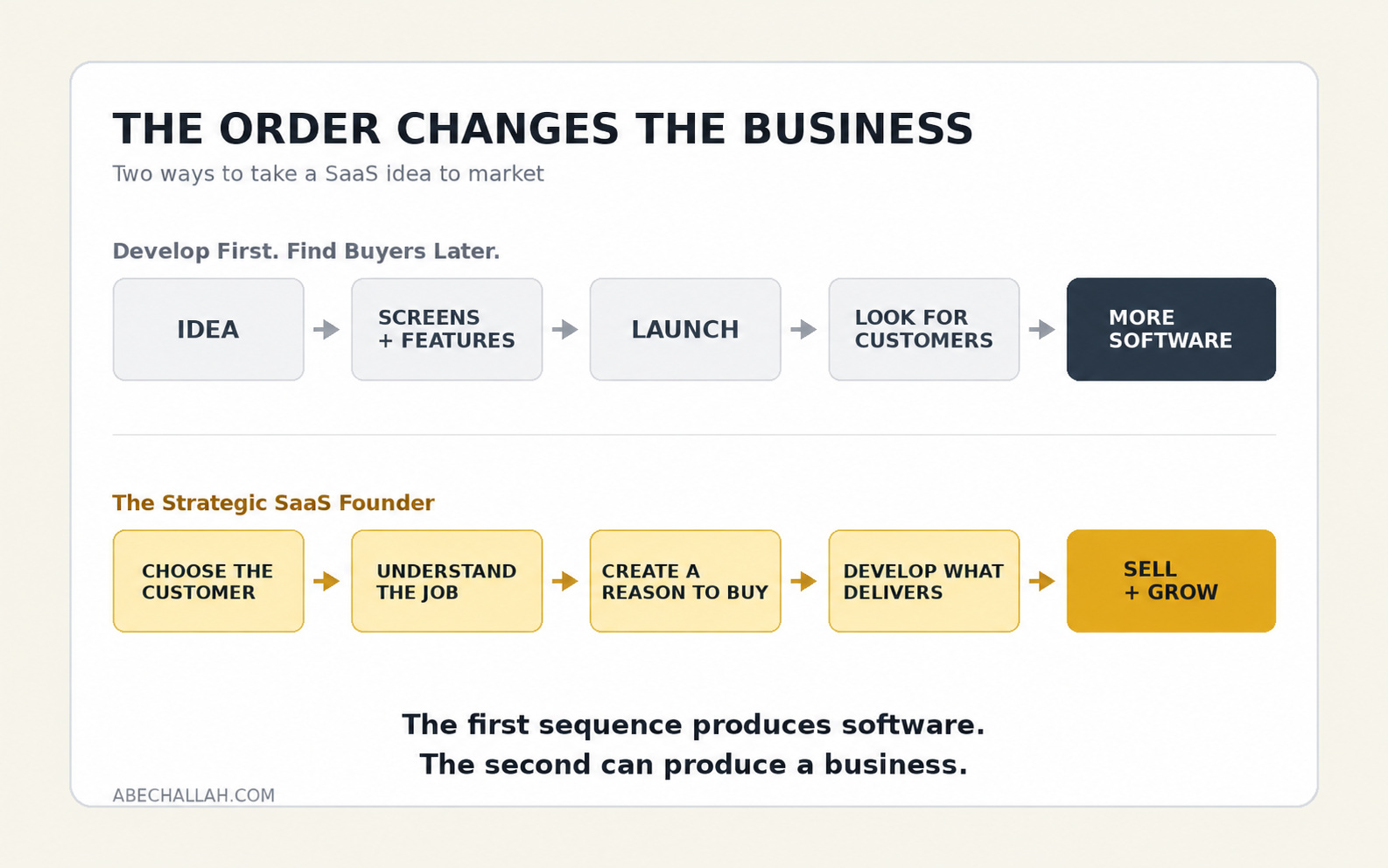
Open the AI development tool. Describe the idea. Generate the screens. Add authentication. Connect a database. Ship the MVP. Find the customers later.
That sequence is backwards.
It produces login pages before customers. Feature lists before advantages. Launch plans before anyone has worked out why the product deserves to win.
I call it Build-First Blindness.
Every visible addition feels like progress. The software becomes more complete while the commercial thinking stays vague.
Before You Build is my answer.
Choose the customer. Understand the job. Find the reason they will choose you. Decide what the first version must prove. Know how you intend to reach the buyer and earn the sale.
Then begin development.
This is what I believe
Sell before you develop
Sales thinking belongs inside the product from the beginning.
The buyer changes the product. The promise changes the product. The price, distribution channel and reason to choose all change the product.
Decide them early.
Every feature should help deliver the promise, prove the advantage or move the customer toward a sale and a successful outcome.
Choose someone
“Small businesses,” “creators,” “marketers” and “everyone who needs this” are crowds.
I want the person who should care most. The person who feels the problem often, understands the value quickly and has a reason to pay now.
Choose whose first choice you want to become.
Speak to them. Shape the workflow around them. Make every unnecessary feature fight for its life.
Put the reason to buy inside the product
A homepage can explain an advantage. It cannot manufacture one.
The advantage may come from the customer you understand, the job you complete, the expertise inside the workflow, the way your product fits into existing work or the irritating steps you make disappear.
This is how you become a Category of 1.
You can have competitors. The buyer can still look at your product and think, “This one was made for me.”
Give them that reason.
Finish more of the job
You found the lead.
And then what?
You detected the traffic drop. You summarized the meeting. You identified the opportunity. You generated a beautiful report explaining exactly what happened.
And then what?
Customers pay for progress toward an outcome. A surprising number of products stop one handoff too early and leave the valuable next step to the customer.
Go after that handoff.
It may contain the next feature, the integration customers will pay for or the better product hiding inside the current one.
Make AI earn its place
ChatGPT, Claude and Gemini keep absorbing features that once justified separate subscriptions.
An AI button proves very little.
Your SaaS must save setup, remember useful context, apply business rules, gather changing information, check the output, coordinate people, complete actions or show whether the work achieved anything.
Ask whether a general AI assistant can complete the whole job with acceptable effort and accuracy.
If it can, your product needs a better reason to exist.
If it cannot, study the gap. That gap may be the product worth making.
Own the last 20%
AI development tools can produce the first version with astonishing speed.
Then an integration behaves differently than expected. The logic gets awkward. A workaround spreads across five screens. Deployment becomes strange. The demo works and the product almost works.
Almost is expensive.
If an AI development tool created the first version, make sure you can access the code, understand what you own and move it elsewhere if the tool becomes a problem. Bring in a developer or technical specialist when you reach the part the prompt cannot fix.
The customer buys the finished experience. The first prompt is your private little memory.
Let product people lead
AI can write code, generate designs, research competitors, prepare content and operate parts of a company.
Someone still has to decide who the product is for, what it should do and which ideas should be ignored.
Product people can now do far more without becoming developers.
Understand the customer. Make the choices. Direct the developers and AI. Evaluate what comes back. Connect every important decision to the buyer and the sale.
AI can give you twenty answers before lunch.
Product judgment is knowing which nineteen to throw away.
Stay small on purpose
A small SaaS company can be deeply ambitious.
One capable founder with good judgment, AI agents and a handpicked set of software can accomplish what once required a large team.
That may be all the team the product needs.
Focused. Profitable. Difficult to copy. Close to their customers. Free to pursue a peculiar idea without explaining it to a room full of investors.
Add people when the work requires them. A large payroll proves nothing.
Judge the product by the sale
A launch means the product went online.
A sale means somebody chose it.
Continued payment means the product kept its promise.
This is the Strategic SaaS Founder
The Strategic SaaS Founder owns the direction.
They know the customer they want, the job worth solving, the reason the product should win and the smallest version capable of proving it.
They use developers and AI to make the product. They choose the customer, direct the work and make sure the software solves the problem it was created to solve.
They make the problem disappear.
Then they make the whole product worth selling and understand the art of making it sell.
I want fewer interchangeable products. Fewer founders hiding behind feature lists. Fewer working applications waiting for the business to appear.
If you cannot explain who the product is for, why it should win and how you expect to sell it, another feature will not save you.
Make something useful. Make it distinct. Finish the job. Make it sell.
Before You Build, know how you will sell.
That is what I am here to help you do.
Whenever you are ready, there are two ways I can help make your product easier to sell:
- Have me review your website, app or SaaS product.
- Work with me one-to-one on your product, positioning and path to buyers.
You can also join Before You Build for practical lessons from the products I test and the patterns I keep finding.