“Everybody is showing you how to vibe code apps. Nobody is showing you how to sell your vibe-coded app.”

Hey, I’m Abe.
I’m a computer engineer specializing in software development and integration. I help SaaS founders make software people actually want to buy.
I started my career at Ericsson and spent over 20 years there working across software development, integration and technical leadership. That gave me a close look at how large international enterprises operate, buy and implement software.
Later, I co-founded simplicityEngine, one of the first no-code drag-and-drop integration platforms. It was quickly adopted by enterprise clients and is still in use today. That gave me an equally close look at the startup world.
I then spent six years leading Business Analysis and Presales at a boutique software agency in Canada. A large part of that job was figuring out what clients needed, what we should propose and how to turn it into something the team could actually deliver. It taught me to look at software development through a business lens.
For five years, I was a course advisor for Ryan Levesque. That’s where I got deep into internet marketing, funnels, launches and the software behind them. I learned that side of the business from one of the best people in the field.
These days, I work with AppSumo, qualifying and evaluating SaaS products and helping prepare them to launch on probably the biggest SaaS marketplace in the world.
I also work directly with SaaS founders, reviewing their products and telling them what I think works, what doesn’t and what I’d change.
I’ve been an AppSumo customer since 2012, long before I started working with them.
Between the products I’ve worked on, evaluated, reviewed and purchased, I see a lot of software.
That gives me a useful lens into what stands out, what looks like everything else in the market, where customers get confused and where a good product may simply be making the wrong impression.
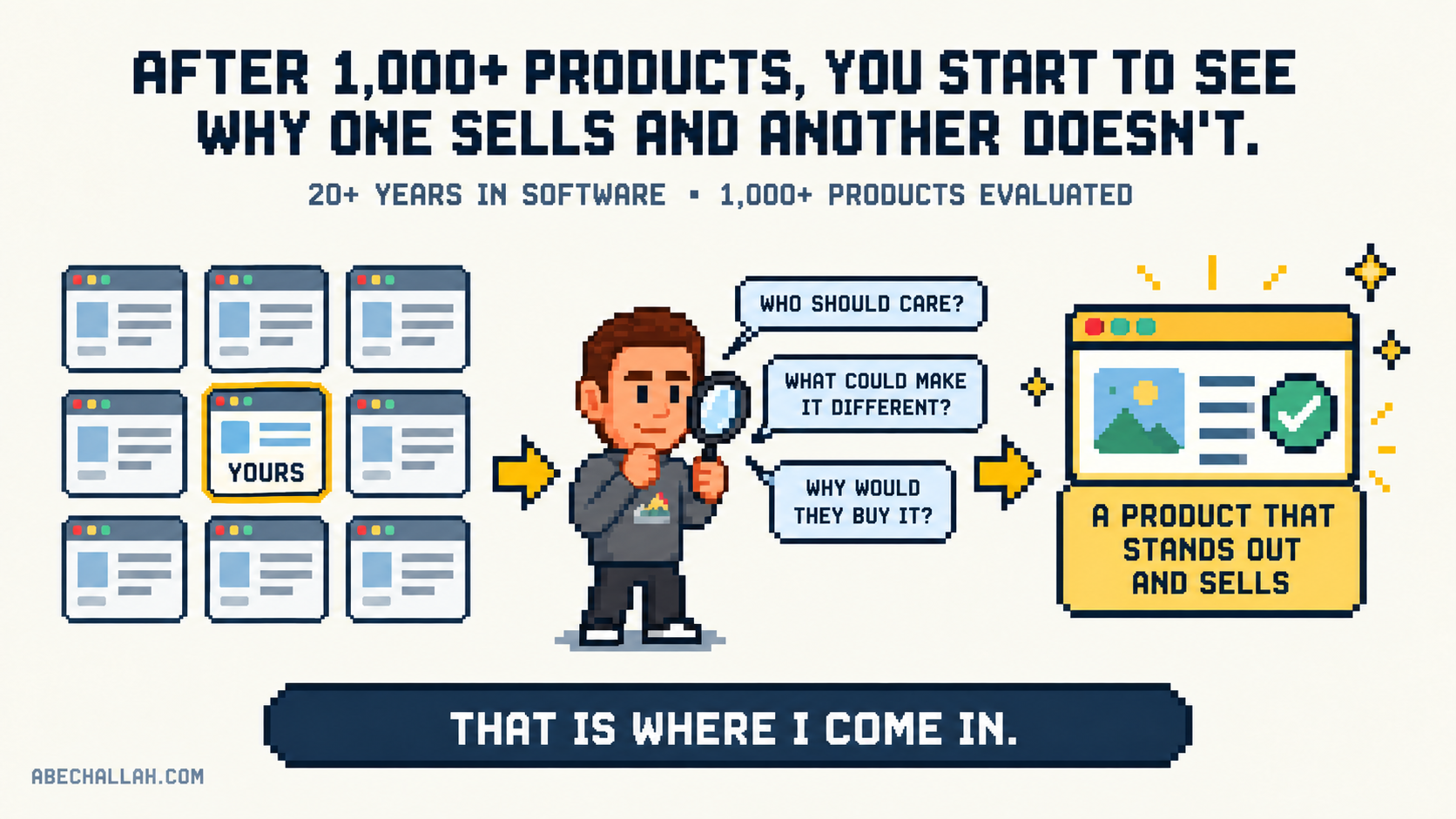
What I help with
Who is this really for?
Why would they choose it?
What advantage does it have?
What is missing?
What should be improved first?
Are we spending time developing things customers will barely notice?
And sometimes:
Is this something people will actually pay for?
A SaaS can work perfectly well and still be difficult to sell.
Sometimes the problem is the product. Sometimes it is the positioning. But most of the time, it is the workflow and the user experience.
How I help make a SaaS easier to sell
1️⃣ Marketplace Insight
I evaluate hundreds of SaaS products through my work with AppSumo.
I see products solving similar problems, going after similar customers and competing for the same money.
After a while you notice patterns. You see what gets attention, what looks like everything else, what customers expect to find, and what makes one product easier to understand and buy than another.
I bring that lens to every product I review.
2️⃣ Product Advantage
Being different is not enough. Different is not always better.
I want to know what advantage the product has.
Does it make something easier? Faster? Less expensive? Does it solve the problem in a better way? Is there a workflow or feature that competitors do not handle as well?
Sometimes that advantage requires changing the product. Sometimes it is already there and nobody is making enough of it.
3️⃣ Customer and Positioning
“Who could use this?” is usually the wrong question.
Almost anyone could use most software.
Who should care enough to pay for it?
That question affects the product, the website, the offer and what you choose to emphasize.
If you do not know who you want to win with, it becomes very easy to make a product for everybody and end up being nobody’s first choice.
4️⃣ Workflow and User Experience
This is where I see a lot of otherwise good products fall apart.
The features may be there, but getting to the result takes too long.
The user gets dropped into an empty dashboard and has no idea what to do next. An important feature is buried. Something that should take two steps takes seven. Or the product makes sense to the person who developed it but not to somebody seeing it for the first time.
Most of the time, when a product works but still feels difficult to use or difficult to sell, I end up looking closely at the workflow and the user experience.
5️⃣ Technical and Execution Judgment
I still look at all of this as an engineer.
There is no point recommending something that sounds great but takes six months, a large team and a pile of infrastructure to develop.
I look at what I would change, what it would take, and whether it is worth doing.
Sometimes the best answer is a new feature. Sometimes it is changing an existing workflow. Sometimes it is removing something. And sometimes the product does not need more development at all.
The newsletter
I write about SaaS, product decisions, differentiation, AI, software I come across and patterns I keep seeing while evaluating products.
AI has made it possible to create software much faster than before.
It also means there are more products competing for the same customers, and being able to make something is no longer the advantage it once was.
Making software has become easier. Making software worth paying for has not.
|
Join 10K+ readers of Before You Build, the newsletter for Strategic SaaS Founders who want to decide what is worth building, make it meaningfully different, and turn it into something people want to buy. |
No spam. Just practical lessons from evaluating hundreds of SaaS products and helping founders make better product decisions.

|
|
– Abe Challah
|